Calcium : Reagent Selection Guide

What is Calcium Detection?

Intracellular calcium ions (Ca²⁺) are important second messengers that play a role in cellular signaling, energy metabolism, and cell death. Abnormal Ca²⁺ dynamics have been linked to cancer cell proliferation and metastasis, neuronal dysfunction in neurological disorders, and age-related declines in cellular function. Therefore, measuring intracellular Ca²⁺ is important for understanding these diseases and developing new treatments. Real-time analysis of calcium dynamics is expected to enable the early detection of pathological changes and the development of new therapeutic strategies.

1) M. Swami, The calcium connection. Nature Reviews Cancer, 2010, 10, 739.
2) L. Kaiani., Calcium dysregulation could underlie lysosomal impairment in Alzheimer's disease, Nature Reviews Neurology, 2023, 19, 65.
3) Y. B. Xiong, et al.,, "Mitochondrial calcium uniporter promotes kidney aging in mice through inducing mitochondrial calcium-mediated renal tubular cell senescence", Acta Pharmacologica Sinica, 2024, 45, 2149-2162.

Recent Reports on Calcium and Related Disease

Cellular Senescence and Calcium

【Summary】 The removal and functional control of senescent cells have attracted considerable attention as a means of preventing and treating age-related diseases, as well as extending healthy life expectancy. Mitochondrial calcium concentration is particularly important because it regulates cellular senescence and cell death. It is also expected to be a target for new strategies to control senescent cells.


C. Margand, P. Morgado-Cáceres, U. Ahumada-Castro, J. César Cárdenas, N. Martin and D. Bernard, Emerging role of mitochondrial calcium levels in cellular senescence and in switching cell fates,  Nature Aging,  2025, DOI: https://doi.org/10.1038/s43587-025-00887-1

Apoptosis and Calcium

 Annexin A5 (AnxA5) is a phospholipid-binding protein and a central regulator of intracellular Ca²⁺ homeostasis. In this study, we demonstrate that AnxA5 regulates mitochondrial Ca²⁺ flux and controls the permeability of the VDAC1 channel in the outer mitochondrial membrane (OMM) under physiological and apoptotic conditions.

F. E. Oflaz, A. I. Bondarenko, M. Trenker, M. Waldeck-Weiermair, B. Gottschalk, E. Bernhart, Z. Koshenov, S. Radulović, R. Rost, Martin Hirtl , Johannes Pilic, Aditya Karunanithi Nivedita, A. Sagintayev, G. Leitinger, B. Brachvogel, S. Summerauer, V. Shoshan-Barmatz, R. Malli and W. F. Graier, Annexin A5 controls VDAC1-dependent mitochondrial Ca2+ homeostasis and determines cellular susceptibility to apoptosis, EMBO J2025, DOI: https://doi.org/10.1038/s44318-025-00454-9

Neurological Disorders and Calcium

In Alzheimer's disease, abnormalities in calcium (Ca²⁺) homeostasis, which are mediated by ryanodine receptors (RyRs), impair lysosomal acidification, protein degradation, and autophagy-mediated clearance. These disruptions are essential for neuronal survival but can be improved by restoring Ca²⁺ homeostasis. This study demonstrates the association between Ca²⁺ control abnormalities and pathological protein accumulation in the early stages of AD, suggesting potential therapeutic targets.


S. M.-Kalimi, W. Gallegos, R. A. Marr, A. G.-Sachs, D. A. Peterson, I. Sekler, and G. E. Stutzmann, Protein mishandling and impaired lysosomal proteolysis generated through calcium dysregulation in Alzheimer’s disease, PNAS2022119(49) e2211999119.

What is the Difficulty of Calcium Detection?

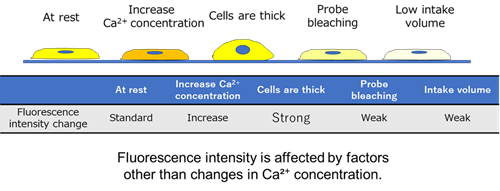
Intracellular Ca²⁺ measurement is commonly performed using calcium probes. However, when measuring for the first time, we often receive inquiries such as, "No change in fluorescence intensity is observed," due to the following issues.

・The probe is not taken up by the cells.
・Results vary depending on cell thickness, probe concentration, etc.
・Cells may become toxic or peel off during the assay.
・Device settings


In order to successfully measure intracellular Ca²⁺, it is necessary to select an appropriate probe according to the experimental system and consider the effects on cell function when performing the assay. Understanding common problems and knowing how to address them in advance will help you conduct the experiment more smoothly and increase the likelihood of success.

Calcium kit Selection Guide

Our kit includes two types of surfactants to aid in the dissolution of calcium probes, as well as one type of anion transporter inhibitor to prevent the probes from leaking out of cells. You can adjust the concentration of each reagent as needed, depending on the cell type and the drugs being added. A measurement buffer is included, eliminating the need for additional preparation. Additionally, you can choose between a Wash type, which is less affected by the measurement system, and a Non-Wash type that does not require washing. This allows you to safely use the kit with cells that are prone to peeling or sensitive to washing, such as nerve cells.

Properties of Calcium Probes


Selection of the Kit

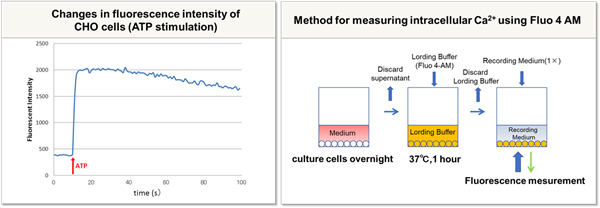
1. For first Ca2+ mesurement:Fluo 4

・It has an extensive track record and is easy to understand due to its ability to discuss changes in fluorescence intensity.
・Wash and non-wash types are available.
・Real-time measurement of changes in intracellular Ca²⁺ concentration due to drug addition.


・First, we recommend using the Wash type, which has a minimal effect on the measurement system. For cells prone to detachment, such as nerve cells, choose the non-wash type.
・A plate reader with an injector is required for real-time measurement of multiple samples.

2. Data measurement with little variation and quantitative determination of Ca2+ concentration:Fura 2

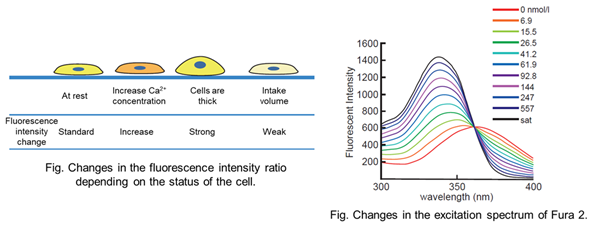
・Ratio measurement suppresses the effects of probe concentration, cell thickness, autofluorescence, and other factors to allow measurement.
Wash and non-wash types are available.

Advantages of ratio measurement

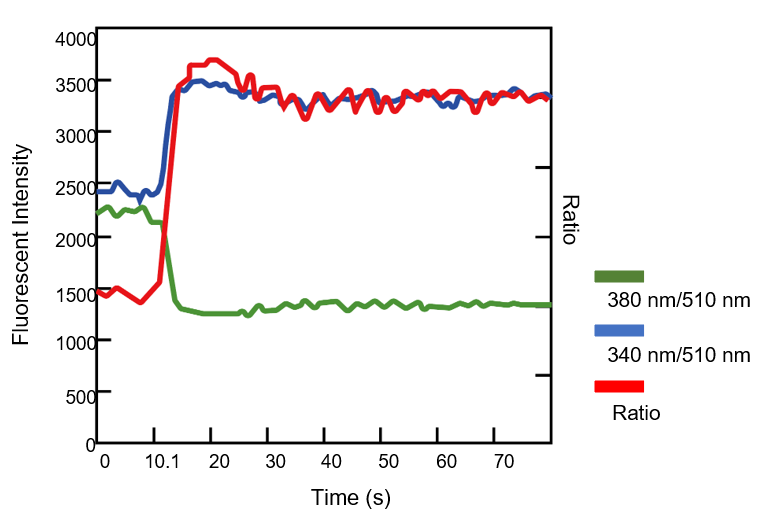
Fura 2 exhibits an increase in fluorescence intensity at an excitation wavelength of 340 nm and a decrease at an excitation wavelength of 380 nm as the concentration of calcium ions (Ca²⁺) increases. Calculating the fluorescence intensity ratio (R = Fex₃₄₀/Fex₃₈₀) suppresses the effects of probe concentration, cell thickness, and autofluorescence, enabling discussion of Ca²⁺ concentration. Due to its ability to obtain less variable data, this method is useful for calculating intracellular Ca²⁺ concentrations.

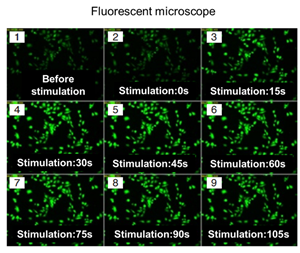
Experimental Example (Fluo 4):Measurement of changes in fluorescence intensity based on calcium concentration in ionomycin-stimulated CHO cells

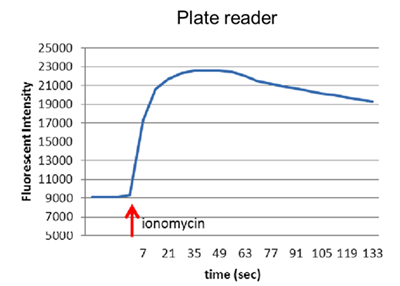
We stimulated CHO cells with ionomycin and measured changes in Ca²⁺ concentration using fluorescence microscopy and a plate reader. These observations and measurements confirmed that fluorescence intensity increased after stimulation, indicating an increase in intracellular Ca²⁺ concentration.

<Applicable products>
Wash Type: Calcium Kit - Fluo 4 [CS22]
Non-wash Type: Calcium Kit Ⅱ- Fluo 4 [CS32]

Experimental Example (Fura2):Measurement of calcium concentration changes by ratiometry in ATP-stimulated CHO cells

We measured changes in Ca²⁺ concentration using CHO cells stimulated with ATP at a final concentration of 1 μmol/L. The addition of ATP increased the ratio of fluorescence intensities at two wavelengths (380 nm and 340 nm), confirming an increase in intracellular Ca²⁺ concentration.

<Applicable Products>
Wash Type: Calcium Kit – Fura 2 [CS23]
Non-wash Type: Calcium Kit Ⅱ- Fura 2 [CS33]

Related Protocols : Troubleshooting Collection

A Practical Guide to Measuring Intracellular Ca²+ for Beginners

-Insight from Customer Support-

We have created a practical guide to intracellular Ca²⁺ measurement for beginners.
It includes information on the principles and characteristics of Ca²⁺ probes, measurement methods, and troubleshooting techniques. Please refer to it for guidance.
The protocol is available for download via the link below.

A Practical Guide to Measuring Intracellular Ca²+ for Beginners


Product Classification

Product Classification