



ExoIsolator II DirectSpin
Centrifugation-Based Exosome Isolation Kit
- No special techniques required
- Simple centrifugation-based exosome recovery
- Recovery performance equal to or greater than ultracentrifugation
-
Product codeEX12 ExoIsolator II DirectSpin
| Unit size | Price | Item Code |
|---|---|---|
| 3 tests | Find your distributors | EX12-03 |
| 10 tests | Find your distributors | EX12-10 |
| 30 tests | Find your distributors | EX12-30 |
| 3 tests | ExoIsolator Ⅱ DirectSpin | x3 |
|---|---|---|
| 10 tests | ExoIsolator Ⅱ DirectSpin | x10 |
| 30 tests | ExoIsolator Ⅱ DirectSpin | x30 |
Simplifying Exosome Isolation
Exosomes are cell-derived extracellular vesicles (EVs) that carry proteins and nucleic acids and mediate intercellular communication. They are widely studied in cancer biology, regenerative medicine, and biomarker research.
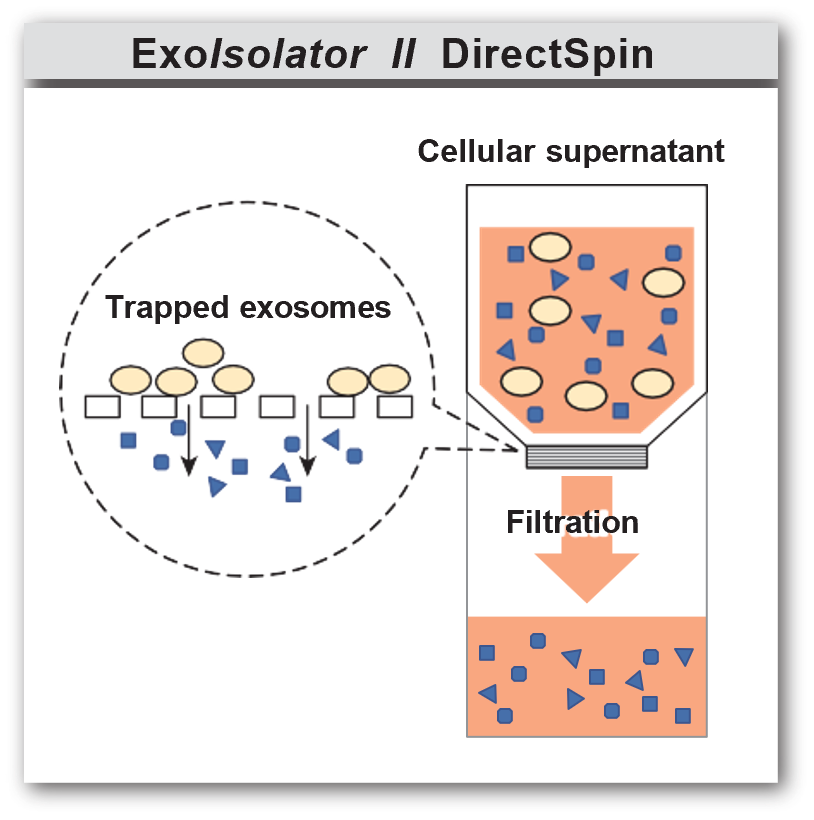
ExoIsolator II DirectSpin enables rapid exosome isolation from cell culture supernatants by simple centrifugation, with recovery comparable to or higher than Ultracentrifugation. By capturing exosomes on a filter rather than forming a pellet, the workflow reduces handling variability and simplifies recovery.
1) Kalluri, R; LeBleu, V. S. “ The biology, function, and biomedical applications of exosomes.” Science. 2020, 367(6478).
Manual

Technical info
Choose the most suitable exosome isolation product for your application. EX12 provides simple, efficient isolation, while EX10 is suitable for rapid isolation from larger sample volumes.
| Product name/Method (Item code) | Ease of Use | Recovery Efficiency (%) | Time | Sample volume | Equipment |
|---|---|---|---|---|---|
|
Exolsolater Il DirectSpin (EX12) |
★★★ | ★★★ |
★ |
★★ 10 ml/tube |
Standard centrifuge |
| ★★ Filter setup required |
★★ Comparable to UC |
★★★ Approx. 5-30 min |
★★★ |
Aspirator | |
| Ultracentrifugation (UC) | ★ Variable |
★★ | ★★ Approx. 2-8 hrs |
★★ Approx. 10ml/tube |
Ultracentrifuge |
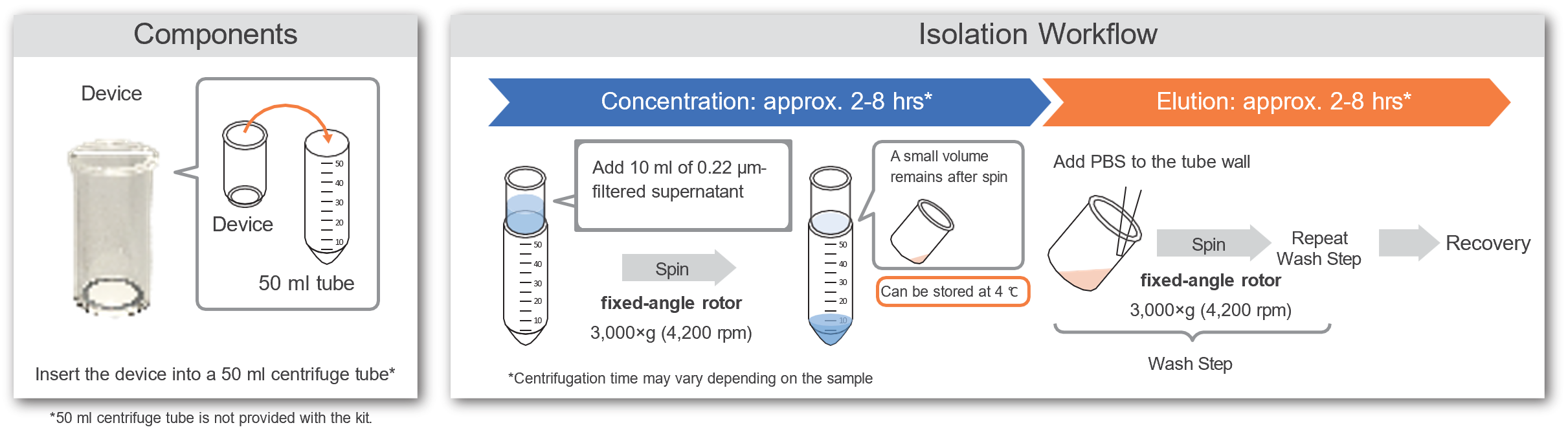
Simple Workflow — Just Centrifuge
Prepare a 0.22 μm-filtered supernatant and centrifuge it to isolate exosomes.
Recovery Performance Equal to or Greater than Ultracentrifugation
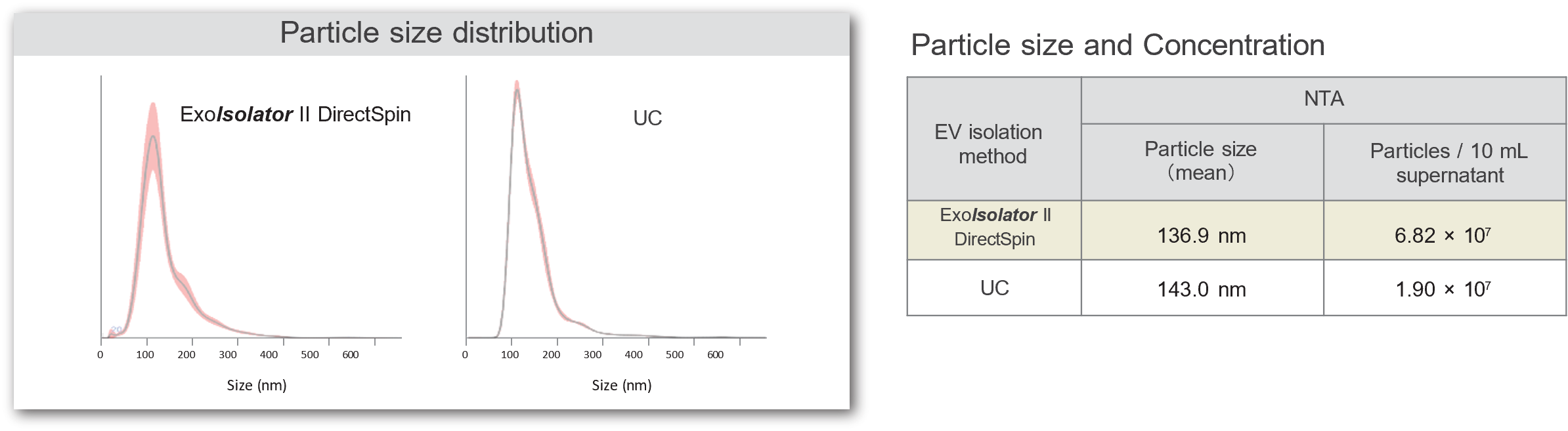
Exosomes were isolated from HCT116 cell culture supernatant using this device or ultracentrifugation. Particle size distribution (left) and particle size and concentration (right) were analyzed by Nanoparticle Tracking Analysis (NTA). This kit showed a comparable size distribution and delivered a higher particle yield than ultracentrifugation.
Experimental Example: Recovery efficiency: EX12 vs Ultracentrifugation
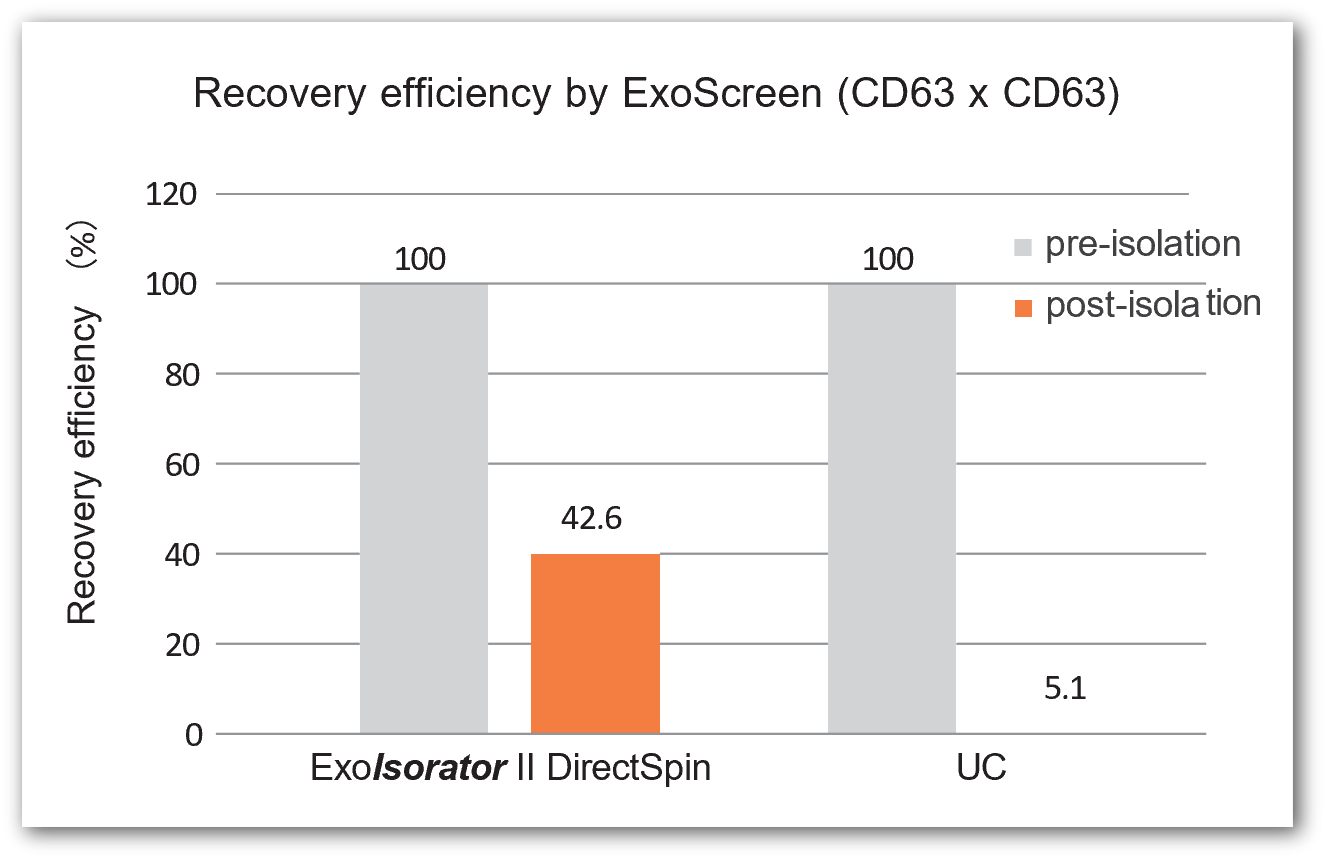
ExoScreen uses two types of exosome surface antibody-conjugated beads: donor beads that emit singlet oxygen upon excitation and acceptor beads that generate a luminescent signal via energy transfer. This allows highly specific detection of exosomes expressing target proteins.
Using CD63 as an exosomal marker, recovery from HCT116 cell culture supernatant was evaluated using ultracentrifugation and this device. The results showed that ExoIsolater II DirectSpin achieved higher exosome recovery than ultracentrifugation (UC).
These data were kindly provided by Dr. Yusuke Yoshioka at Tokyo Medical University and Institute of Medical Science.
Q & A
-
Q
What is the size range of particles that can be recovered?
-
A
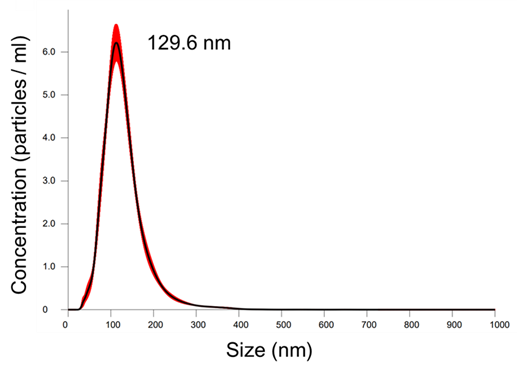
Particles approximately 100–200 nm in size can be recovered.
Reference:
Particle size distribution of particles recovered from HEK293S cell culture supernatant
-
Q
What sample volume can be processed?
-
A
For cell culture supernatant samples, the recommended processing volume is 1–10 mL. Please note that the required centrifugation time may vary depending on the sample.
-
Q
How many particles can be recovered from cell culture supernatant?
-
A
The amount of exosomes secreted varies depending on the cell type, so the amount of particles recovered may also vary depending on the cell type and culture conditions. As an example, we have recovered particles from 10 mL of HEK293S cell culture supernatant cultured under shaking conditions, with the following results:
Recovered protein amount: 131 μg
Recovered particle count: 2.5 × 10¹⁰ particlesNote: The protein amount was measured using the BCA assay, and the particle count was measured by nanoparticle tracking analysis.
-
Q
Can exosomes be recovered from the culture supernatant of cells cultured in serum-containing medium?
-
A
We do not recommend using serum-containing medium. Serum used for cell culture, such as FBS, also contains exosomes. Therefore, exosomes recovered from serum-containing cell culture supernatant may include serum-derived exosomes, which could affect experimental results.
-
Q
Can the recovered exosomes be stored?
-
A
The recovered exosomes can be stored at 4°C for 1 to 6 months. For long-term storage, store them at −80°C. To minimize repeated freeze–thaw cycles, aliquot the exosomes before storage.
Reference:
Yoshioka, Y. and Ochiya, T. (2020). Exosome Experimental Guide. ISBN: 978-4-7581-2246-7.
-
Q
Can a swing-bucket rotor be used instead of a fixed-angle rotor?
-
A
Yes, a swing-bucket rotor can also be used. However, our internal validation has shown that the particle recovery efficiency when using a swing-bucket rotor is approximately half that achieved with a fixed-angle rotor.
When using a swing-bucket rotor, set the centrifugation conditions to 2,000 × g.
-
Q
Can a sterile filtration filter with a pore size larger than 0.22 μm be used for sample pretreatment?
-
A
Yes, a sterile filtration filter with a pore size larger than 0.22 μm can also be used. However, pretreatment using a 0.22 μm sterile filtration filter is recommended, as centrifugation may take longer when using filters with larger pore sizes.
-
Q
What is the exosome recovery efficiency?
-
A
The recovery rate may vary depending on the sample.
As an example, the recovery rate was evaluated by re-purifying commercially available bovine milk-derived exosomes using ExoIsolatorⅡ DirectSpin. The result is shown below:
Particle recovery efficiency: 26.7%
Note: Please refer to the experimental examples in the instruction manual for details.
Handling and storage condition
| Store at room temperature |
Related products
The following related products are also used in research related to this product.
-
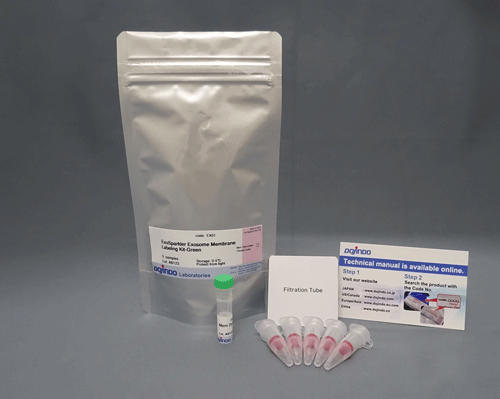
Exosome Membrane Fluorescent Staining
ExoSparkler Exosome Membrane Labeling Kit-Green
-
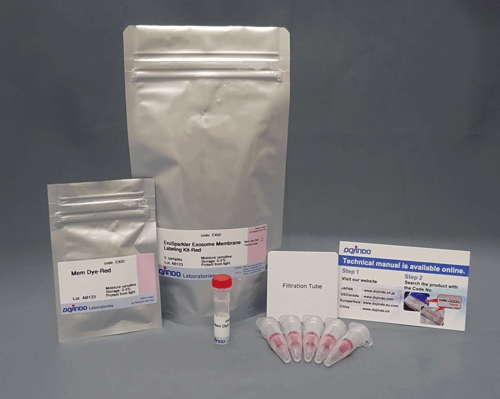
Exosome Membrane Fluorescent Staining
ExoSparkler Exosome Membrane Labeling Kit-Red
-
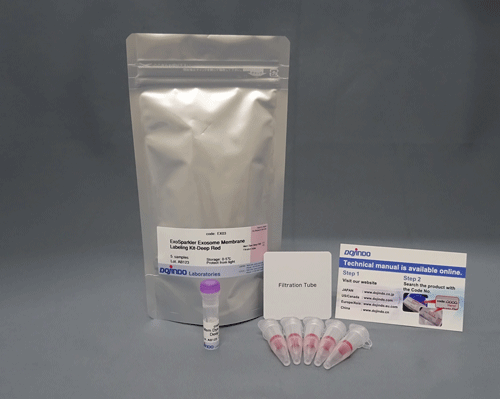
Exosome Membrane Fluorescent Staining
ExoSparkler Exosome Membrane Labeling Kit-Deep Red
-
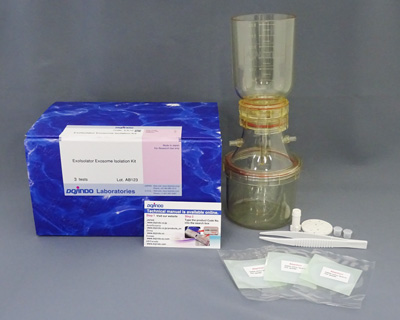
Exosome Isolation Kit
ExoIsolator Exosome Isolation Kit
-
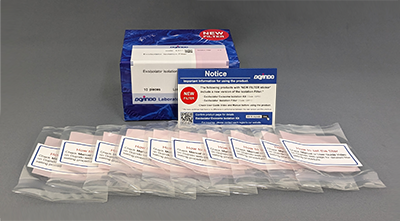
Filter for exosome isolation kit
ExoIsolator Isolation Filter


